Dr. Gymbro
←

#exogenous ketones

2 articles
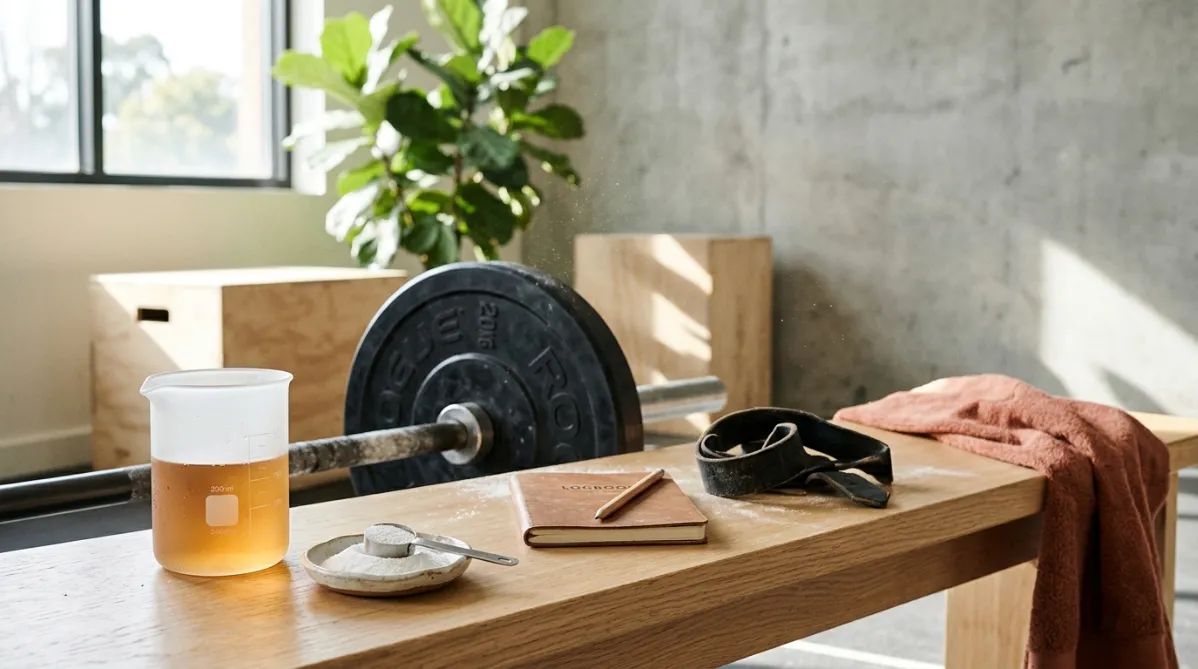
A wide, editorial-style still life shot from a slightly elevated three-quarter angle on a pale oak gym bench, lit by soft morning window light. In the foreground sits a minimalist matte-white glass beaker of clear, faintly amber liquid, with a few condensation droplets on its surface. Beside it rests a small ceramic dish of white crystalline powder and a stainless steel scoop. In the middle ground, a chalk-dusted steel barbell with black bumper plates rests on the bench's edge. A pair of worn leather lifting straps and a small notebook with a pencil lie nearby, suggesting data logging. Behind them, softly blurred, is a bright, airy studio with concrete walls, a wooden plyo box, and a tall leafy plant catching the light.

The palette is warm and muted: cream, sand, soft sage green, and charcoal, with one small accent of burnt orange in the amber liquid and a terracotta towel draped over the bench. Fine chalk dust floats in sunbeams that cut diagonally across the frame. The shallow depth of field keeps the beaker and barbell sharp while the background melts into creamy bokeh. Composition follows the rule of thirds, with the beaker on the left third and generous negative space on the right for headline text. The mood is calm, premium, and contemporary, like a high-end wellness and sports-science magazine photograph with subtle film grain, natural shadows, and realistic textures.
nutrition

Les cétones ont maintenu une production de force 8 % plus élevée, mais les sauts n’ont pas changé

BY DR. GYMBRO ·

Une dose de 50 g de bis‑octanoyl‑(R)-1,3‑butanediol a fait grimper le taux sanguin de cétones à ≈ 2,2 mM et a permis de conserver un taux de développement de la force (RFD) 8 % plus élevé une heure après ingestion, sans aucune amélioration du saut en contre‑mouvement. L’étude, réalisée chez 20 adultes actifs, montre un effet potentiel sur la fatigue de force, mais reste préliminaire.

A wide, editorial-style photograph of a runner's morning ritual on a quiet paved path at the edge of a park, shot in soft golden-hour light with a shallow depth of field. In the foreground, a small frosted glass bottle of pale amber liquid sits on a weathered wooden bench, beside a sleek analog stopwatch and a folded linen towel. Condensation beads on the glass and catches warm sunlight. The background melts into a creamy blur of a lone runner in a muted sage-green jacket and charcoal tights, mid-stride, heading away along a tree-lined track, with soft mist hovering above the grass.

The color palette is calm and modern: warm honey and amber tones, soft sage green, off-white, and touches of deep navy in the shadows. Subtle film grain and gentle natural contrast give it a contemporary lifestyle-magazine feel. Long, delicate shadows stretch across the path.

On the bench, a small open notebook with a loose hand-drawn sketch of a head profile and a simple line graph sits next to a pencil, hinting at cognition and measurement without any text legible. A few fallen autumn leaves add texture. The composition follows the rule of thirds, with the bottle and stopwatch on the left third, negative space on the right for headline overlay, and the runner small in the distance to suggest that speed is not the story.

The mood is thoughtful, clean, and quietly intelligent, evoking wellness science journalism: minimal, airy, organic, and refined. No futuristic elements, no neon, no digital effects, just natural light, tactile materials, and a considered, understated aesthetic.
supplements

Les esters de cétones n'ont pas rendu les coureurs plus rapides – mais ont aiguisé leurs esprits

BY DR. GYMBRO ·

Les boissons à base d'ester de cétones sont présentées comme un raccourci pour courir plus vite, mais un essai de 31 jours n’a pas montré d’amélioration sur 5 km. Ce qui a changé, en revanche, est frappant : des temps de réaction plus rapides au test de Stroop et au basculement de tâches, une glycémie réduite de 15 % et une VO₂ plus élevée lors d’un test progressif, même après l’arrêt du dosage. Le point faible réside dans la petite taille de l’échantillon, avec seulement 18 coureurs récréatifs dans une étude en simple aveugle. Voici ce que les données révèlent, ce qu’elles ne montrent pas, et qui devrait éviter un régime de 90 g/jour.

This page is available in